
Native Advocacy in the United States
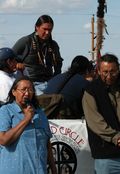
In 2011, Tillie Black Bear met with U.N. Special Rapporteur Manjoo to inform SR Manjoo of the difficulties faced by Native American survivors of domestic and sexual violence in obtaining prosecutions against their perpetrators. Native women were being denied judicial remedies because Tribal Courts and non-Tribal Courts could not agree on which court, if any, had jurisdiction over perpetrators who were not members of the tribe but committed violent crimes on the reservation. Tribal Courts were hampered by lack of clear authority to prosecute criminally non-native perpetrators of violent crimes. While some non-native courts denied any authority to prosecute crimes occuring on the reservation, even those who believed that they had authority rarely prosecuted sexual assault perpetratred against native women. Consequently, there was no punishment for non-native perpetrators who came onto reservations and sexually assaulted women. Predictably, the rates of sexual assault of native women are higher than that of the general population. Conservatively, 1 out of 3 Native women will be raped in her lifetime and 3 out of 5 will be physically assaulted. Native women brought their plight to the Inter-American Commission on Human Rights in 2011.
For years advocates worked to provide a remedy. The remedy sought was to grant Tribal Courts jurisdiction over perpetrators who committed violent crimes on the reservation. The proposal stirred opposition that was sometimes based in racial bias. For example, some argued that white men could not receive a fair trial in Tribal Court.
Finally in the 2013 Violence Against Women re-authorization contained the jurisdictional provision for which Tillie Black Bear had advocated for so long. Tribal Courts are now able to prosecute those who enter onto reservations and commit violence.
Tillie Black Bear, who passed on this July, was a grandmother of the contemporary battered women’s movement. Tillie’s national advocacy dated back to 1978 when she testified at the first U.S. Commission on Civil Rights hearing on “wife beating”.
Tillie Black Bear, of South Dakota, was a strong and effective advocate for native women in designing federal legislation. Tillie was instrumental in founding the National Coalition Against Domestic Violence as well as the South Dakota Coalition Against Domestic and Sexual Violence. Her work on her native Rosebud reservation continued, as well, where she was a founding mother of the White Calf Buffalo Woman Society. In 2000, President Clinton honored Tillie with an Eleanor Roosevelt Human Rights Award. In making the award the president stated: “For more than 20 years, Tillie Black Bear has been a strong voice for Native American and women’s rights and a leading advocate for victims of domestic violence. She founded the first shelter for battered women on an Indian reservation in 1977 and has worked with energy and determination to prevent domestic abuse, provide counseling and empower women with the tools they need to succeed.”
One of Tillie’s notable characteristics was her persistence. Her achievements came about after years of advocacy. Tillie’s persistence over so many years, ultimately achieving remedies for native women in major federal legislation, was strategic and measured. She was faithful to her native heritage and principles, in 2003 holding a Wiping of Tears ceremony at the Senate building.
Those of us who continue working in the field have much to learn from Tillie’s nearly forty year journey through human rights advocacy.