
Working in Dilley, Texas – A Law Student’s Experience
Editor’s note: Margaret Drew introduces Michael Duenas, third year law student who worked helping detained, undocumented mothers during his spring break. Michael is wearing a red tie in the posted photo.
He writes:
My name is Michael Dueñas and I am a third year enrolled in the Immigration Law Clinic at UMass School of Law. This is my fourth semester in the clinic. Through my involvement in the clinic and my volunteer work with the immigrant community in New Bedford, I have been 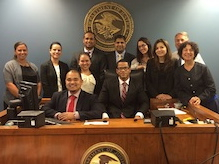
The CARA project is an ambitious humanitarian project that provides legal aid to those arriving from Latin American countries without proper documentation to enter the United States. The Catholic Legal Immigration Network, the American Immigration Council, the Refugee and Immigrant Center for Education and Legal Services, and the American Immigration Lawyers Association, are collectively known as CARA.
The chain of events that the undocumented detained mothers go through is as follows. First, the mothers are presumably detained at the border by Customs and Border Patrol or they self-report at an inspection site. Once they are in ICE custody, they are taken to a holding facility that has no chairs or beds, simply benches and concrete floors. Sometimes the stay at this facility is short, but based on the information we obtained from the mothers, the stays usually last several days. The women are forced to sleep sitting down on the bench or on the floor and the lights are never turned off. They are fed ham and bread. They are not allowed to shower and given minimal, if any, medical attention. The mothers refer to the two faculties where they are originally detained as the “Ice Box” and the “Dog Pound”. Finally, the mothers are then taken to the facility in Dilley. All of the mothers have their children with them, kids between ages 1-4 .
I was able to talk to mothers from Mexico, Guatemala, Honduras, and El Salvador. They all shared their unique stories with me. As one mother told me as she fought back tears and her daughter was grasping at her trying to get her attention, “we didn’t want to leave our home, but if we stayed, we would have died.”
A different mother told me that her husband was kidnapped by the Zetas drug cartel because he could not pay the tax imposed by the cartel. When I inquired further, she told me, “we didn’t have money to eat, how were we going to pay the tax?” The drug cartel came for him. This mother told me that when the cartel came to take her husband, she tried to stop them by holding on to her husband. But she was pushed to the ground by the backside of a riffle. That same night she took her four kids and fled. First to a friend’s house, who gathered up money from friends and neighbors for a bus ride to Laredo. They all got off the bus and walked up to a Customs and Border Patrol officer and asked for help.
Then there was the mother who thought a family member might be able to pay a bond for her. So I took her into a room with a phone and we called her relative. After I introduced myself, I gave the phone to the mother. The mother started crying, telling her relative that she was okay, they were okay, for her relative not to worry. They were alive and not to worry about money they had $40. They were alive, therefore they made it. They crossed thousands of miles on their own and made it with $40 left in their pockets. I let that sink in. The mother and children had fled their home, with no plan on returning, and they were, as she put it, “fine”. They fled because they had to for safety. They are “fine” because they are alive.
Then there was a declaration that I took for a mother who did not pass her credible fear interview. When this happens, the volunteer lawyers and law students take declarations from the women, document them in English, and prep the client to go before an Immigration Judge. The following are portions of her declaration:
On February 20, 2016, we fled for the United States.
After I realized that the gang knew where we were, we decided to flee to the United States. Unfortunately, I did not have enough money for all three of us. We sat down as a family and decided that only one of my children and I would go. I had to leave my daughter behind with my sister. It pains me to have left her, but my other child was the one in danger. The Mara 18 wanted him.
I had to get my son out. We were not safe anywhere. My daughter understood and supported the decision. It breaks my heart to have had to choose between my son and my daughter. As a mother, I wanted to bring them both, but I did not have enough money, so she had to stay.
CARA persuaded the Immigration Judge to overrule this mother’s credible fear interview decision. For the time being, this mother and son did not have to return to their hell. For the time being they were allowed to stay.
There were several hundred mothers there, with their children, unable to go home. They no longer had a home. All of these mothers had horrific stories. They fled as result of violence. They were here asking for help. Asking for a new home. The women held at the Dilley Detention Center are amazing mothers. They are all fearless warriors. They all came to the United States fleeing harm. They all came with their children. They all came asking Lady Liberty to grant them asylum.
I have had a few transcending life experiences: my college days, my Peace Corps Service in Costa Rica, and these last few years in law school. My week in Dilley is now one of those experiences. Even though it was much shorter in duration, the mothers that I met that week, the stories that they shared with me, and the courage that I witnessed, will forever be with me.