
U.S. failure to engage in constructive dialogue with U.N. experts during the 2023 ICCPR Review – Part I
By Ámbar Reyes Pérez, Musa Siam, Roaa Hussien, 3Ls at UIC Law, and Professors Sarah Dávila A., and Lauren E. Bartlett
This two-part post builds on the previous post written by Profs. Dávila A. and Bartlett on the 2023 ICCPR review.
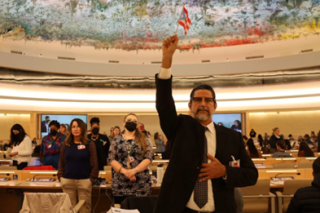
On October 18. 2023, U.S. civil society engaged in a spontaneous protest over the failure of the U.S. government delegation to engage in constructive dialogue with the U.N. Human Rights Committee (“Human Rights Committee” or “Committee”). Photos and videos of that protest when viral, with news media and social media across the globe discussing the protest without knowing the context. During closing remarks by U.S. Ambassador Michèle Taylor during the Human Rights Committee’s Fifth Periodic Review of the United States, U.S. civil society members silently stood up and turned their backs. Once the ambassador completed her remarks and the Committee Chair Tania María Abdo Rocholl began her closing remarks, civil society members sat back down. This silent protest was a powerful statement by U.S. civil society organizations expressing frustration and outrage over the U.S. delegation’s failure to reply to the Committee’s important questions about broad domestic and foreign policy human rights issues from systemic racism, militarization, mass incarceration, reproductive health, immigration, detention, as well as the U.S. failure to protect civilians and prevent mass atrocities in Gaza.
This blog post attempts to address what the constructive dialogue between the Human Rights Committee and the government delegation is supposed to look at during the country review process and helps to explain why the U.S. civil society delegation was spurred on to engage in that powerful protest on October 18.
How the treaty reporting procedure and constructive dialogue is supposed to happen
Once countries (“State parties”) have ratified the International Convention on Civil and Political Rights (the “ICCPR”), then the country is subject to periodic reviews by the Human Rights Committee of its compliance with the treaty. The Committee begins the reporting process (under its Article 40 of the ICCPR obligations) by first composing the Country Report Task Force, composed of 4-5 members of the Committee who will lead and direct the periodic reporting process, and a country rapporteur who is the person leading the drafting of the list of issues and coordinating different procedures throughout the reporting process (with the Human Rights Committee Secretariat’s support), including organizing the substantive contribution of Committee members in the reporting process.
Generally, the review consists of four steps: (1) submission of State party initial or periodic report; (2) constructive dialogue between the State party and the Committee, which includes in-person meetings in Geneva with government delegates and civil society; (3) the Committee issuing Concluding Observations; and (4) follow-up to those Concluding Observations.
The Committee’s examination of State party reports is pursuant to Rule 68 of its Rules of Procedure. These reports must be based on the list of issues created and shared by the Committee with the State party. That list of issues helps frame the scope of the review, including for the purposes of the constructive dialogue.
The United Nations General Assembly passed resolution 68/268 (Apr. 2014) and encouraged collaboration between treaty bodies to create an aligned methodology to be used in constructive dialogue with State parties. The aim of this methodology is to make the dialogue more effective and productive, as well as to maximize the available time for productive dialogue. (Res. 68/268, at para. 5) Additionally, it asked that the Committee, and other treaty bodies, “adopt short, focused and concrete concluding observations…that reflect the dialogue with the relevant State party.” (Res. 68/268, at para. 6). Moreover, during the in-person review in Geneva, the country is invited to bring a delegation with representatives from different bodies, agencies, and entities that may respond to questions posed by the Committee.
The purpose of this constructive dialogue is to elicit an effective process in which the Committee analyzes and reviews human rights developments in the State Party under a specific treaty. In general, the face-to-face dialogue follows the same broad structure for all treaty bodies: (a) the State party is invited to send a delegation to attend the meetings at which the committee will consider the report of the State party; (b) the head of the delegation, usually a representative of the Government of the State in question, is invited to make a brief opening statement; (c) members of the Committee, in some cases led by the country rapporteur(s) or country task force, pose questions on specific aspects of the report of particular interest or concern; and (d) the State party delegation responds to those questions.
An initial review requires a comprehensive assessment by the Committee of the enjoyment by all of the rights in the ICCPR concerned and the related compliance by the State party. A periodic report is more focused on previous recommendations made by the Committee. In practice, however, and with some degree of variation between the different treaty bodies, the difference between the dialogue concerning an initial report and a periodic report is minimal.
The formal review, in person in Geneva, then takes place over two consecutive working days with a three-hour session on each day. These public sessions are usually attended by UN observers, civil society representatives, which may include directly impacted persons, and a National Human Rights Institute (“NHRI”) if the State Party has one. However, the U.S. does not have an NHRI. An NHRI’s purpose is to promote and safeguard human rights domestically. It is an independent, non-governmental entity that establishes productive relationships with the government and with non-governmental organizations (“NGOs”). Some key functions of NHRIs include providing advice to the government, monitoring human rights within the State and within its actions, and engaging with the broader international human rights community. NHRIs are regulated by the 1993 Paris Principles which establishes responsibilities, composition, and operating methods.
While the Biden Administration has “centered” human rights in the execution of U.S. foreign policy, it has not established an NHRI. The lack of a U.S. NHRI was a question posed by Committee member Soh during the first day of the review in October 2023. The U.S. delegation response follows a long trend of the U.S. abstaining from “mainstream international human rights standards.”
An NHRI may help facilitate the work of a National Mechanism for Reporting and Follow-up (“NMRF”). The NMRF is supposed to coordinate and prepare reports on a country’s human rights developments. It is also supposed to engage with regional and international human rights mechanisms to track and follow-up with domestic implementation of treaty obligations. The NMRF performs its duties by consulting with the NHRI and with civil society organizations to ensure its approach is comprehensive in safeguarding human rights.
A lack of both an NHRI and a NMRF hinders the U.S.’s ability to consistently and timely report to the Committee, and such hindrance affects the promotion and enjoyment of human rights across the nation. A lack of both an NHRI and a NMRF also hindered the constructive dialogue between the Committee and the government delegation during the 2023 U.S. Review.